26
Feb
Leather Dog Collar Buying Guide
How to Choose the Right Leather Dog Collar: Size, Padding & Hardware
Deploy the right collar on day one. This field-tested guide covers measurement, sizing, padding strategy, width selection, and hardware specs—so your leather collar delivers comfort, control, and long-term ROI.
Step 1 — Measure for Fit (the “Middle-Hole Rule”)
- Measure the base of your dog’s neck with a soft tape. Do not measure an old collar—neck first, always.
- Add two fingers of ease between tape and neck for comfort and breathing room.
- Target the middle holes of the collar’s adjustment range. This future-proofs seasonal coat changes and weight fluctuation.
Outcome: you’re selecting a collar size that lands your current neck measurement near the middle hole—not the tightest or loosest.
Step 2 — Use the Size Chart (cm)

| Size | Total Length (A) | Min Neck (B) | Max Neck (C) | Width (D) |
|---|---|---|---|---|
| XXS/XS | 39 | 22.5 | 33 | 2.5 |
| S/M | 48 | 33 | 43 | 2.5 |
| L/XL | 55 | 40 | 50 | 2.5 |
| 2XL/3XL | 63 | 48 | 58 | 2.5 |
| 4XL/5XL | 71 | 56 | 66 | 2.5 |
E = D-Ring location for leash, ID tag, or accessories.
Quick Breed Mapping (guidance, not gospel)
- XXS/XS (22.5–33 cm): Yorkie, Chihuahua, Mini Dachshund.
- S/M (33–43 cm): Beagle, Corgi, French Bulldog, Mini Aussie.
- L/XL (40–50 cm): Border Collie, Standard Poodle, Pit Bull.
- 2XL/3XL (48–58 cm): Labrador, Golden Retriever, Husky.
- 4XL/5XL (56–66 cm): German Shepherd, Rottweiler, large mixes.
Pro tip: between sizes? Upsize and rely on the middle holes for micro-adjustments.
Step 3 — Pick Your Comfort Strategy: Padded vs. Unpadded
Padded collars reduce friction on short coats and sensitive skin, especially on high-mileage days. See our padded orange leather dog collar for a comfort-first build. Unpadded full-grain works well for long coats or low-friction use cases—e.g., blue leather dog collar.
Step 4 — Choose Width (Load Distribution)
Your current lineup standardizes at 2.5 cm width—an all-around spec that balances pressure distribution with day-to-day comfort. For power breeds or heavy pullers, pair width with padding + robust hardware for best outcomes.
Step 5 — Select Hardware (Strength + Aesthetics)
- Antique Brass: corrosion-resistant with heritage optics. Example: Blue Leather Dog Collar.
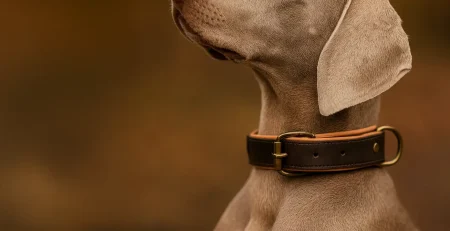
- Matte Black Coated Steel: modern, low-gloss finish with daily-use durability. Example: Dark Brown Leather Dog Collar.
Both options pair a secure buckle with a heavy-duty D-ring placed beside the buckle for smooth leash and tag attachment.
Decision Matrix (TL;DR)
- Active / Sensitive Skin: padded collar, same width, rust-resistant hardware.
- Everyday / All Coats: full-grain leather, 2.5 cm width, brass or matte hardware.
- Visibility & Style: select high-contrast colorways (e.g., lime green leather dog collar or orange leather dog collar).
Care & Maintenance (Keep It Performing)
- Wipe down with a damp cloth after muddy or salty outings.
- Air-dry away from heat; avoid soaking.
- Condition lightly every 1–3 months to maintain softness and color depth.
Deeper dive here: How to Clean & Condition Your Leather Dog Collar.
Ready to execute? Fast-path links:
- dark brown leather dog collar
- blue leather dog collar
- green leather dog collar
- purple leather dog collar
FAQs
How tight should a leather collar be?
Snug but not restrictive—two fingers should slide between collar and neck. If you’re on the first or last hole, reassess size.
My dog is between sizes—what now?
Upsize. You want your current measurement near the middle holes to enable micro-adjustments.
Which is better for pullers?
Padded full-grain leather with robust hardware. Combine with training to reduce load on the neck.